I recently founded Lenivis LLC. So far, it has made exactly $0 in revenue.
Setting up the company was surprisingly easy, largely thanks to AI.
The process involved setting up Google Workspace, purchasing domains, configuring business email addresses, filing the LLC formation paperwork with Washington State, obtaining an EIN (Employer Identification Number), registering the business with Washington State and the City of Seattle, opening a business bank account, and setting up Stripe.
There were plenty of smaller tasks too, like getting a business phone number.
But for the most part, I just followed my AI agent's instructions and clicked through forms, filling in whatever information it asked for. Almost everything was done in about two weeks.
Here's what it actually cost:
| Item | Cost |
|---|---|
| Washington State LLC formation | $200 |
| WA business license and trade name registration | $55 |
| Seattle business license | $41.41 |
| Mailbox notarization | $25 |
| Total | $321.41 |
There are additional costs for domains, Google Workspace, and other services.
I'm planning to focus on two main areas:
- koe, a voice-to-text SaaS application
- AI implementation and custom solution development for businesses
1. koe, a Voice-to-Text App
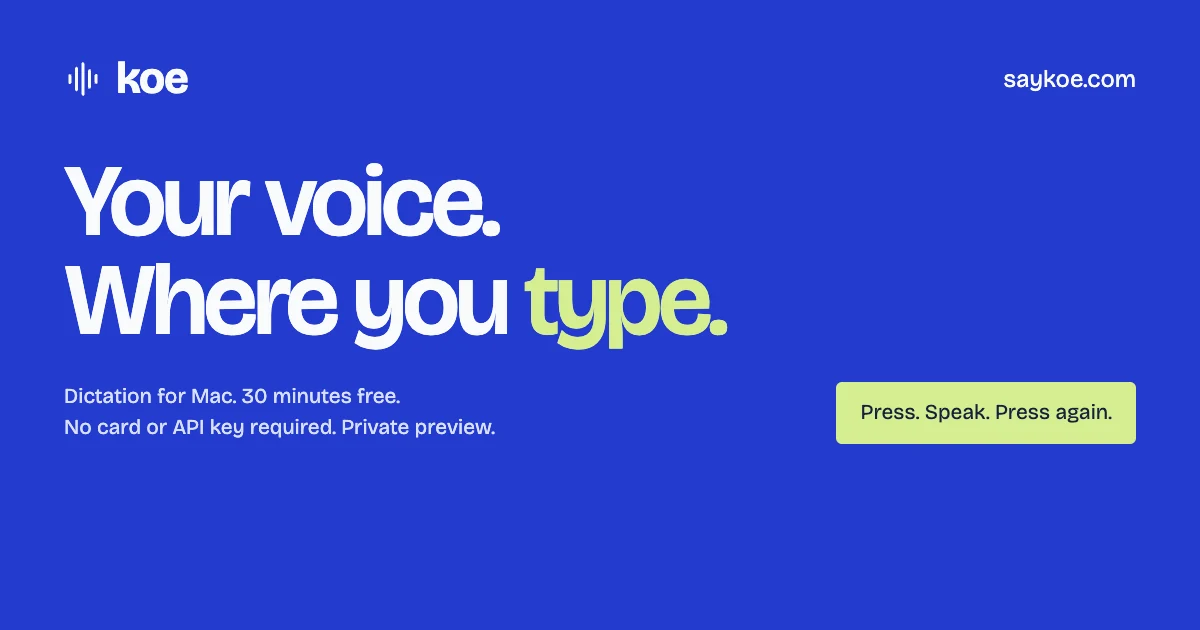
This started purely as a personal side project.
I use voice dictation all the time, and speaking to AI has pretty much become my default way of interacting with it. I wanted to build my ideal voice-to-text tool: something extremely fast, comfortable to use, and eventually available across all my devices.
My goal is to deliver better performance and usability than Wispr Flow, at the lowest price I can reasonably offer.
I'm a big fan of macOS utilities like Maccy and Magnet, and I want koe to feel as close to those apps as possible.
I believe the best tools are the ones you barely notice. They should feel like a natural extension of how you work, letting you get things done without thinking about the tool itself.
That's the philosophy behind koe.
I had the core functionality working in just a few days, but refining the UX has taken several times longer.
AI has dramatically lowered the barrier to building functional software. But I still think human taste and judgment play a huge role in making a product genuinely pleasant to use.
I'm planning to release koe publicly soon, and I'd love for you to give it a try.
Behind the scenes of building koe
I'm pretty obsessive about details, so I've been finding endless things to complain about: the onboarding doesn't feel right, the UI looks off, interactions are too slow, I don't like the animations, filler words aren't being removed properly, and so on.
Once I started obsessing over latency, I ended up building a benchmark that feeds the same audio into Wispr Flow for comparison. Splitting longer recordings into chunks and sending requests while I'm still speaking makes it feel much faster.
| Recording length | All at once | In chunks |
|---|---|---|
| 8–15 sec | 1.88 sec | 1.69 sec |
| 15–25 sec | 2.31 sec | 1.34 sec |
| 25–40 sec | 3.01 sec | 1.91 sec |
Building the native SwiftUI app every time I wanted to check a small change was painfully slow. So I switched to prototyping the UI in HTML first, iterating quickly, and only building the native version once I was happy with the result.
Production release builds have two gates: measured latency must be no worse than Wispr Flow, and all of the roughly 20 P0 end-to-end test scenarios must pass.
Before I knew it, I'd reached version 17 of my UX review.
I think this applies to pretty much anything. Getting something to a decent level is relatively easy, but trying to make it perfect can take an absurd amount of time.
When I made a lyric video a while back, the most time-consuming parts were the tiny details: HDR exports, text rendering quality, animations, encoding settings, and so on.
That last millimeter always takes the longest.

I also really related to a recent demo of Rex from Superlogical, a project by Mitchell Hashimoto.
Obsessing over these little details is honestly one of my favorite parts of engineering.
AI agents can now build software that works well enough, but I think there's still plenty of room for human judgment when it comes to deciding what feels intuitive, polished, and genuinely enjoyable to use.
2. AI Implementation and Custom Solutions for Businesses
The second area is helping businesses adopt AI and build custom solutions.
Companies like Cresta and Sierra have been gaining a lot of traction in the AI agent space. Personally, I think there's still enormous untapped demand for AI adoption, especially for internal business operations.
I already use AI extensively in my day-to-day engineering work, and I'm fairly confident that I've become very effective at using it to improve my productivity.
At the same time, I don't think businesses necessarily need another platform sitting between them and the underlying AI models.
With tools like the Claude Agent SDK and OpenAI's SDKs, I believe it's possible to build solutions for a wide range of business problems directly.
What I want to do is pretty simple: understand a client's business problems, design and implement an AI-powered solution, and deliver something they can actually use.
The closest analogy would be an AI-focused version of Classmethod, a Japanese technology consultancy known for helping businesses adopt and implement cloud technologies.
Rather than just teaching companies how to use AI, I want to understand their workflows and build actual, working solutions.
On the technical side, the idea is to use existing SDKs and APIs while having Lenivis handle everything from understanding business requirements to system integration and ongoing operations. I want to keep the architecture as simple as possible without introducing unnecessary dependencies on intermediate platforms.
I've only just started working on the business development side of this, so the plan is to start small, build experience, and gradually establish a track record.
LLMs have made it possible for individuals to accomplish so much more than before.
I'm really enjoying both product development and exploring new business opportunities. I've been spending most of my time outside my day job working on these projects, and there's still so much more I want to do.
So for now, these are the two areas I'll be focusing on.
Thanks to all my friends and everyone else who took the time to read this. I appreciate your continued support.
Yuya